
Fuel testing plays a critical role in protecting fuel quality, supporting regulatory compliance, and maintaining confidence across the petroleum supply chain. From refineries and terminals to independent testing laboratories, the industry depends on standardized methods that produce accurate, defensible data under real-world operating pressures. Many of these methods have been developed by ASTM International.
There are ASTM methods covering a broad range of fuel properties, including volatility, vapor pressure, sulfur content, octane-related characteristics, hydrocarbon distribution, and oxygenate concentration. Standardized fuel analysis methods provide laboratory teams with analytical frameworks for consistent execution and decision-making.
As fuel formulations have evolved, that consistency has become more difficult, and more important, to maintain. Modern fuels are more complex than traditional hydrocarbon blends. Oxygenated gasoline, ultra-low sulfur fuels, renewable blending components, and tightly controlled aromatic content all place greater demands on analytical methods. Laboratories are expected to detect and quantify target compounds with precision, while also maintaining throughput and audit readiness.
That is one reason gas chromatography (GC) continues to hold such a central place in modern fuel testing.
The Enduring Value of GC in Fuel Analysis
Among the analytical techniques used in fuel testing, GC remains one of the most important for compositional analysis. Its strength lies in its ability to separate volatile compounds within complex fuel matrices and quantify them with the sensitivity and reproducibility required for today’s regulatory and quality expectations. The ASTM D02 committee continues to maintain a large set of GC-based fuel methods, reflecting the technique’s ongoing importance in the sector.
In practical terms, GC gives fuel laboratories the resolving power needed to distinguish between hydrocarbons and oxygenates that may be present at low concentrations but still have significant regulatory or performance implications. When laboratories need confident identification and quantitation of specific compounds, GC is often the technique that makes that possible.
GC works by separating volatile compounds within a sample as they pass through a chromatographic column, typically capillary or packed, before detection, most often by flame ionization detection (FID). This combination of separation and sensitive detection allows laboratories to resolve individual hydrocarbons and oxygenates, even at low concentrations, making GC especially well-suited to today’s testing requirements.
Why GC Matters Even More Today
Several industry trends have increased the importance of GC-based ASTM methods in fuel testing.
Stricter environmental and product-quality requirements have driven the need for more precise compositional data. Laboratories must often measure regulated or performance-critical compounds at lower levels, with tighter tolerance for variability. In those settings, analytical sensitivity and reproducibility are essential.
The rise of oxygenated and engineered/alternative fuel blends has also added complexity to routine testing. Compounds with similar structures must be separated and quantified accurately in matrices that are no longer analytically straightforward. GC provides the separation capability needed to support that level of specificity. For example, ASTM D3606 which covers the determination of benzene and toluene in finished spark-ignition fuels or ASTM D4815 which covers the determination of ethers and alcohols.
Methods like these can be used to generate data for regulatory use, blending control, and process optimization. ASTM’s current fuel-method listings reflect how widely gas chromatography is used across petroleum and fuel applications, from oxygenates and aromatics to light hydrocarbons and biodiesel-related analyses.
At the same time, expectations around traceability and defensibility have increased. Laboratories are under pressure to deliver data that supports product release decisions, regulatory submissions, quality investigations, and customer reporting. That raises the bar for method control, calibration confidence, and repeatability.
Advances in GC instrumentation have strengthened its position further. Improvements in capillary columns, automation, temperature programming, and digital workflow integration have supported better repeatability and higher throughput, allowing laboratories to handle more demanding methods with greater efficiency.
Reliable Results Depend on More Than the Instrument
While GC is central to many ASTM fuel methods, strong results don’t come from instrumentation alone. Method performance depends on the quality of the entire analytical workflow: reference materials, sample preparation practices, and quality control routines all contribute to the reliability of the result.
For laboratories working in petrochemical testing, this is where analytical confidence is built. Accurate calibration, traceable values, and fit-for-purpose materials help reduce avoidable variability and support long-term confidence in data. That is why laboratories don’t just look for a method they can run. They look for workflows they can trust.
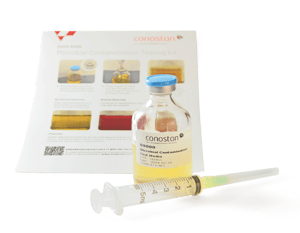
At AnalytiChem, we support these priorities through CONOSTAN®, our established and trusted brand for petroleum testing solutions, with products designed to deliver precise calibration, consistent analytical performance, certified traceability, and dependable support for real laboratory workflows.
For quality managers, this consistency translates into essential operational stability. A recognized ASTM method is the foundation, but the supporting materials around that method are what help laboratories execute it with confidence day after day.
GC Continues to Set the Standard
ASTM includes a number of important fuel testing methods that cover a range of analytical methods, but gas chromatography remains one of the techniques that laboratories rely on when compositional accuracy matters most. As formulations evolve and regulatory expectations increase, GC-based methods continue to provide the resolution, specificity, and reproducibility needed to support fuel quality decisions with confidence.
For laboratories focused on dependable results, the question is not whether GC has a place in fuel testing. It’s how to optimize their method execution with the right standards, consumables, and workflow controls to ensure reliable performance every time.
Support your ASTM fuel testing workflows with confidence. Explore AnalytiChem’s fuel and petroleum testing solutions including: trusted calibration standards to help improve accuracy, reproducibility, and day-to-day laboratory performance.