Environmental Monitoring in Hospital Cleanrooms: From Periodic Testing to Integrated Contamination Control
Written By: AnalytiChem |
Practical guidance for hospital pharmacy aseptic units.
In this article, you’ll learn:
-
Why hospital pharmacy cleanrooms carry a higher contamination risk than their size suggests
-
What a risk-based environmental monitoring program requires in practice
-
How to select the right combination of active, passive, surface, and rapid monitoring methods
-
What continuous antimicrobial technology adds, and what it doesn’t replace
-
How an integrated contamination control strategy reduces both compliance risk and operational pressure
Why hospital pharmacy cleanrooms face heightened scrutiny
Hospital pharmacy aseptic units occupy an unusual regulatory position. Where a manufacturing authorisation is held, EU GMP Annex 1 — the European Commission’s requirements for the manufacture of sterile medicinal products — applies in full. Where national licensing exemptions exist, the position is more nuanced: regulators across Europe, and inspection bodies including the UK’s Medicines and Healthcare Products Regulatory Agency (MHRA) and the European Medicines Agency (EMA), increasingly apply Annex 1 contamination control principles proportionally, using patient risk as the determining factor, rather than production scale or batch size. In the US, hospital pharmacy compounding is governed primarily by USP <797>, with state boards and accreditation bodies applying varying levels of scrutiny that are converging toward stricter contamination control requirements.
The logic is straightforward. The populations served by hospital pharmacy — oncology patients, neonates, immunocompromised individuals — are precisely those for whom a contaminated preparation presents the greatest clinical risk. A hospital that produces 10 units of a cytotoxic preparation per day is not subject to lower contamination risk than an industrial sterile manufacturer; in some respects, the opposite is true. Smaller batches, frequent product changes, short shelf-life preparations, and the pressures of a live clinical environment all compound the challenge. Purpose-built manufacturing facilities can be designed and validated around a fixed process. Hospital cleanrooms often cannot.
This is the context in which modern environmental monitoring (EM) programs for hospital pharmacy should be understood. The question is not simply whether a facility meets its current monitoring requirements on paper — it’s whether the monitoring program, the contamination control strategy (CCS), and the evidence base behind both are sufficient to defend the safety of the preparations being produced.
The requirements of Annex 1
At the heart of Annex 1 is the CCS: a formally documented, facility-wide framework that identifies critical control points and the design, procedural, technical, and monitoring measures used to manage contamination risk. The CCS is not a static document — it’s a live system that drives the entire monitoring program, including sampling locations, frequencies, alert and action limits, and deviation procedures.
Annex 1 defines four cleanroom grades. Grade A is the critical zone for high-risk aseptic operations, with a guidance value for unidirectional airflow or 0.36–0.54 m/s at the working position, and zero microbial growth. Grade B is the background environment for Grade A where no isolator is used. Grades C and D apply to less critical preparatory stages. For hospital pharmacy aseptic compounding, Grade A within a Grade B background is the standard requirement for open-product operations.
The 2022 revision of Annex 1 formalised a shift in approach. Where earlier guidance centered on periodic testing as evidence of control, the revised text emphasises continuous environmental control as the objective, with monitoring as the means of verifying that control. The distinction matters practically: a monitoring program that detects excursions after the fact, without the procedural infrastructure to investigate and correct them systematically, does not meet the intent of the regulation.
For viable particle monitoring, Annex 1 specifies that microorganisms recovered in Grade A and B areas must be identified to species level, supporting trend analysis and root cause investigation. Alert levels and action limits are defined separately: an alert level indicates potential drift and triggers scrutiny; an action limit triggers investigation and corrective and preventive action (CAPA). Any growth in a Grade A area must trigger an investigation. Requalification of Grade A and B environments is required every six months.
The primary contamination source, and why it matters for method selection
In hospital cleanrooms, as in pharmaceutical manufacturing, the primary source of viable contamination is personnel. Skin cells, respiratory particles, and clothing fibres carry microorganisms that, if not adequately controlled, can become airborne or deposit on surfaces. Common isolates — coagulase-negative staphylococci, Micrococcus, Corynebacterium, Bacillus spp., and environmental moulds including Aspergillus and Penicillium — reflect this human and environmental origin.
This has direct implications for how monitoring programs should be structured. Personnel monitoring strategies — fingertip plates and contact plates on gown surfaces — are not optional additions to air and surface sampling. They are a direct measure of the most significant contamination vector, and one that the CCS must address explicitly. Similarly non-negotiable are surface monitoring of high-touch areas, transfer hatches, and equipment in proximity to critical operations.
Airflow patterns and HVAC systems represent the secondary risk. Cleanrooms designed for industrial sterile manufacturing are engineered to minimize turbulence and dead zones around critical operations. Hospital cleanrooms — particularly those retrofitted into existing buildings — may face inherent airflow challenges. Monitoring data, correctly interpreted, should be capable of detecting these patterns; a monitoring program that samples only the most accessible locations will not.
Active and passive air sampling: complementary, not interchangeable
Air monitoring in Grade A and B environments is conducted by two methods, each with distinct roles.
Passive air sampling uses settle plates to collect microorganisms that sediment from the air over time. Under Annex 1, settle plates in Grade A and B areas must be exposed for the full duration of operations, changed as required, with a maximum exposure of four hours. Exposure time must be validated: media must not desiccate during exposure, since desiccation of agar reduces microbial recovery and undermines the validity of the result. This requirement has direct implications for the quality and formulation of media selected for settle plate use — deep-fill plates are recommended to extend working time.
Active air sampling — volumetric impaction sampling — quantifies microorganisms per unit volume of air (CFU/m³). SAS air samplers are among the most widely used systems for this purpose in regulated environments. They draw a defined volume of air through a sampling head, impacting microorganisms onto the culture medium surface. The sampler’s biological and physical efficiency should be characterised, including the d50 value — the particle diameter at which collection efficiency is 50% — since impaction can impose physical stress on microorganisms, particularly at higher flow rates.
Active samplers and settle plates are not mutually exclusive in environmental monitoring. Active sampling provides quantitative volumetric data; passive sampling reflects deposition over time and is sensitive to low-level, sustained contamination that a spot measurement may not capture. Used together, and trended over time, they provide complementary evidence of control that’s more complete than either method used in isolation.
Surface monitoring and the role of culture media
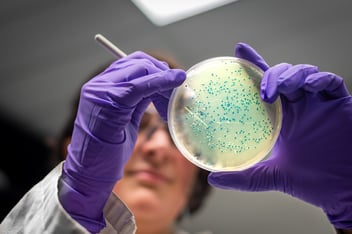
Contact plate sampling is the standard method for quantitative surface monitoring in hospital cleanrooms. Plates are pressed against the surface to be sampled, providing a count of viable microorganisms and, after incubation and identification, a characterisation of the organisms recovered. Contact plates offer direct colony mapping, enabling spatial analysis of contamination distribution across critical work zones and high-touch surfaces. For irregular or difficult-to-reach surfaces — equipment joints, transfer hatch seals, complex geometry — swabbing provides a flexible alternative that sacrifices some quantitative precision for accessibility.
In environments where chemical disinfection with sporicidal agents and quaternary ammonium compounds (QACs) is routine — as Annex 1 requires in Grade A and B areas — the culture media used for contact plate sampling must contain appropriate neutralising agents. Without these, residual disinfectant on the sampled surface will carry over onto the plate and suppress growth, producing false negative results. Sampled areas should also be wiped after plate contact to remove any agar residue.
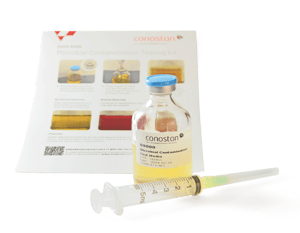
Redipor® prepared culture media is designed for use in regulated monitoring environments, offering ready-to-use formats — both off-the-shelf and customisable — that eliminate the variability associated with in-house preparation. This isn’t simply a convenience argument: Annex 1 requires that media used for environmental monitoring be tested for growth promotion before use, with a justified combination of reference microorganisms and representative local isolates. For hospital pharmacies relying on outsourced or supplier-tested media, the regulation specifies that transportation and storage conditions must be considered in that justification. Ready-to-use prepared media with documented quality control, validated formulation, and appropriate neutraliser content directly addresses this compliance requirement.
The same media quality principles apply to settle plates used for passive air monitoring. Validated exposure time, confirmed freedom from desiccation risk, and demonstrated growth promotion performance are all compliance requirements, not optional quality attributes.
Rapid monitoring methods: a complement to culture-based testing
Adenosine triphosphate (ATP) bioluminescence testing provides near real-time feedback on surface cleanliness by measuring total organic residue — microbial and non-microbial — in seconds rather than the days required for culture incubation.
The technique is particularly well suited to hospital cleanroom environments where rapid decisions are needed: post-cleaning verification before a production run begins, immediate checks of transfer hatches and gowning room surfaces after disinfection, or confirmation that a high-touch area has been adequately cleaned following an unplanned intervention. Results are available quickly enough to influence operational decisions in a way that culture-based methods cannot.
ATP testing does not, however, provide the species-level identification or quantitative CFU data that Annex 1 requires for formal EM records, and total organic residue is not equivalent to viable microbial contamination. It’s best understood as a complementary operational tool — one that adds a rapid verification layer to the monitoring program without substituting for culture-based surface and air sampling.
Continuous antimicrobial technology: what it adds to the program
Traditional chemical disinfection programs, however well-designed, are episodic: they reduce contamination load at defined intervals, but microbial populations begin recovering immediately after each cycle. In high-traffic areas such as gowning rooms, airlocks, and transfer corridors, this recovery can be rapid. Environmental monitoring confirms the state of the cleanroom at the time of sampling; it doesn’t control contamination between sampling intervals. Continuous antimicrobial technology is an important component of Annex 1, and addresses that gap.
Spectral Blue MWHI® (Multi-Wavelength High-Intensity) is a patented technology that provides a continuous, automated layer of antimicrobial control independently of the manual cleaning cycle. The technology uses two blue-light wavelengths — 405 nm and 430–470 nm — to excite porphyrins and flavins, light-sensitive molecules naturally present in microbial cells. This excitation generates reactive oxygen species (ROS) that damage cellular structures and inactivate the organism.
Unlike UV-C disinfection systems, Spectral Blue is designed to operate within photobiological safety limits (IEC 62471) for use in occupied spaces. It’s UV-free, produces no ozone or mercury, and leaves no chemical residue. Efficacy extends to bacteria, yeasts, molds, biofilms, and antibiotic-resistant strains. Four Spectral Blue device formats are available to cover biosafety cabinets and laminar flow hoods, benches and smaller rooms, mobile flexible deployment, and whole-room coverage.
Spectral Blue doesn’t replace monitoring or manual disinfection. Rather, it reduces the baseline microbial burden that monitoring is attempting to measure and manage, addressing the contamination control gap between cleaning cycles. In cleanroom boundary areas that see frequent personnel movement, a lower sustained contamination pressure translates to more consistent EM results and, over time, a more robust trend record, contributing to the demonstrable state of control that regulators expect to see.
Building an integrated contamination control strategy
The shift from periodic monitoring to integrated contamination control is a shift from measurement to management. Annex 1’s emphasis on CCS reflects this: the regulation doesn’t simply require data — it requires evidence that the data is understood, acted upon, and driving improvement.
This shift is also a response to a pattern that’s common even in established EM programs: monitoring, cleaning, and disinfection treated as separate functions rather than as components of a single system. Monitoring data that isn’t connected to a structured CAPA framework generates compliance paperwork without quality insight. Disinfection programs that aren’t verified by representative sampling provide no evidence of efficacy. And over-reliance on visual inspection — which doesn’t correlate with microbiological cleanliness — remains a recurring gap in facilities where monitoring programs have not kept pace with regulatory expectations.
A well-constructed hospital cleanroom contamination control program integrates three functions. Reduction minimises the contamination burden through facility design, personnel protocols, cleaning and disinfection procedures, and, where appropriate, continuous antimicrobial technology in high-risk boundary areas. Monitoring generates reliable, representative data through appropriately selected active and passive air sampling, surface monitoring, and personnel monitoring methods, using validated, quality-controlled culture media. Verification ensures that data is trended, excursions are investigated, and that the results feed into documented corrective actions and periodic program review.
For hospital pharmacies reviewing their EM programs, the immediate priorities are typically: confirming that sampling locations, frequencies, and action limits are risk-justified and documented; ensuring continuous non-viable particle monitoring is implemented in Grade A areas and generating valid data; verifying that culture media in use meets growth promotion requirements under documented supply and storage conditions; reviewing personnel monitoring against actual operational risk, rather than minimum procedural requirements.
These steps don’t require large-scale infrastructure change. What they do require is a clear-eyed review of whether documented procedures reflect actual operational practice, because even apparently mature EM systems can have gaps between the two.
From compliance to confidence
Environmental monitoring in hospital cleanrooms isn’t about satisfying an inspector — it’s about producing consistent evidence, over time, and ensuring the safety of preparations sent to patients. The regulatory framework exists because regulators stipulate that this evidence needs to be systematic, documented, and traceable. The clinical imperative is more fundamental than that.
Facilities that understand their EM program as a quality management tool rather than a compliance exercise tend to be better placed on both counts. They detect excursions earlier, respond to them more effectively, and accumulate a trend record that both supports their own quality decisions and withstands external scrutiny.
The investment in doing this well — in selecting the right monitoring methods, using validated media, integrating continuous contamination reduction, and building a functioning CAPA infrastructure — is inseparable from the investment in patient safety.
AnalytiChem supports hospital cleanrooms across the contamination control cycle: Spectral Blue continuous antimicrobial technology for sustained microbial reduction, SAS air samplers for active volumetric monitoring, and Redipor ready-to-use prepared culture media for air, surface, and personnel monitoring in GMP-regulated environments. Contact our team to discuss your environmental monitoring requirements, Redipor prepared media options, or to request a free Spectral Blue 3D disinfection planning consultation.
Environmental Monitoring in Hospital Cleanrooms: Frequently Asked Questions
Does EU GMP Annex 1 apply to hospital pharmacy cleanrooms?
What’s the difference between an alert level and an action limit in environmental monitoring?
Why does culture media quality matter for environmental monitoring compliance?
When should I use active air sampling versus settle plates?
What role does continuous antimicrobial light technology play in an EM program?
Subscribe to our blog