The Redipor® BetaBag: Reducing Risk, Downtime, and Waste in Sterile Media Transfer
Written By: AnalytiChem |
Streamlining introduction of sterile media without compromising contamination control.
In this article, you'll learn:
-
Why prepared media transfer is a contamination risk point in isolators and RABS
-
How the Redipor® BetaBag simplifies sterile media introduction, increases efficiency, and reduces waste
-
How the BetaBag supports EU GMP Annex 1 and FDA aseptic processing expectations
-
The operational benefits of closed media transfer
-
How the process works via an explainer animation, and Redipor BetaBag FAQ
Why is prepared media transfer a contamination risk point?
Environmental monitoring (EM) programs are designed to protect sterile manufacturing environments. However, one of the most risk-sensitive stages of the process is the transfer of prepared microbiological media into isolators or restricted access barrier systems (RABS).
In traditional workflows, prepared media plates are removed from outer packaging, passed through a transfer hatch, subjected to vaporized hydrogen peroxide (VHP) decontamination, unwrapped again within the sterile workspace, where they are stored until needed. If additional plates or alternative media types are required, the process is repeated.
Each handling step introduces opportunity for variability. Each VHP cycle interrupts workflow, requires validation and aeration time, and contributes to operational delay. Multiple packaging layers add cost and waste. Although well established and widely validated, this process introduces multiple handling steps that increase complexity and operational burden.
Under EU GMP Annex 1 and U.S. FDA aseptic processing guidance, such process steps must be scientifically justified within a documented contamination control strategy. Simplification—where sterility assurance is maintained—reduces both risk and regulatory burden, as well as increasing efficiency and productivity.
What is the Redipor BetaBag and how does it work?
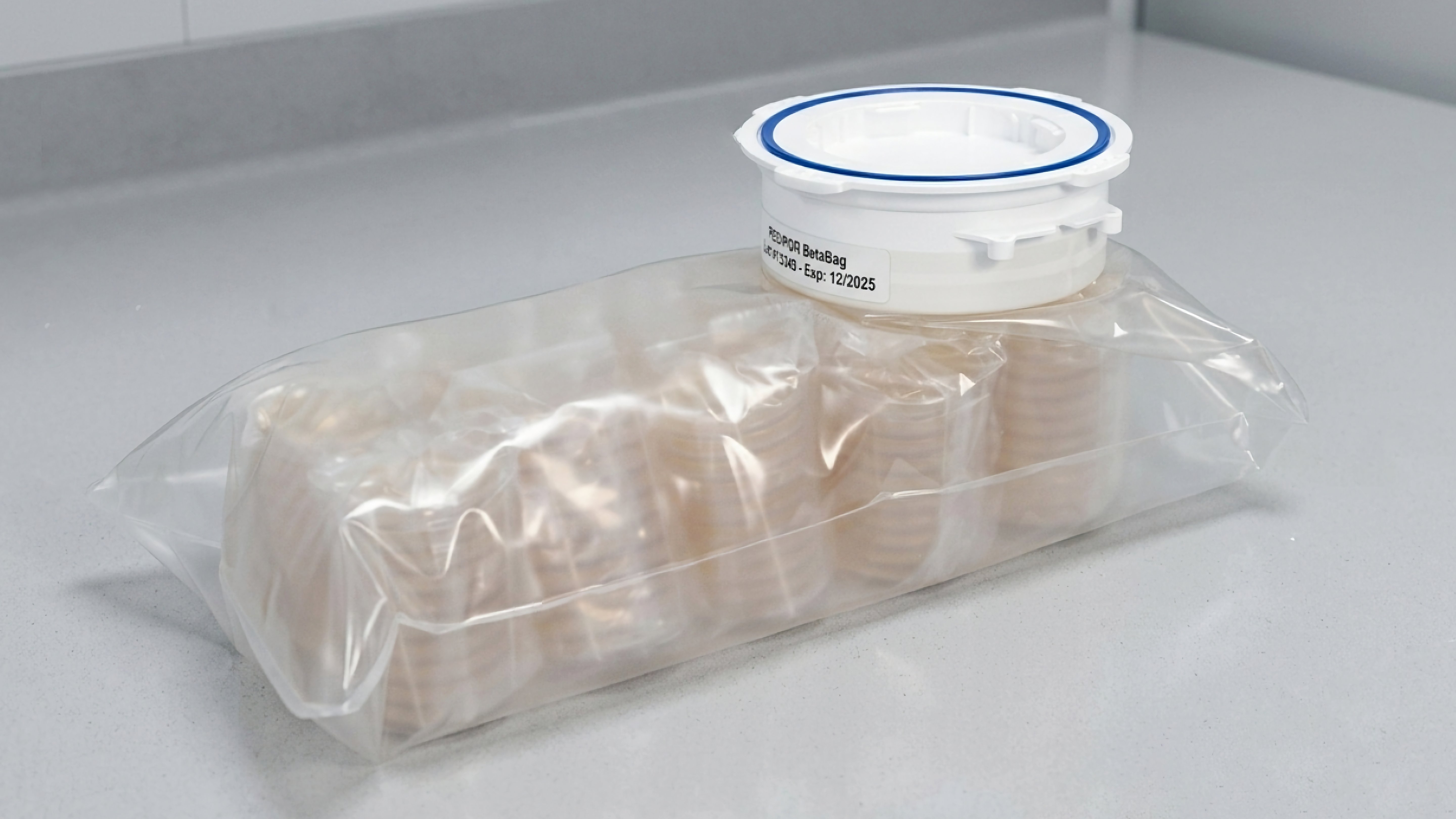
The Redipor BetaBag is a closed transfer system designed to introduce gamma-irradiated prepared media, sterilised using validated processes, into sterile environments via compatible alpha ports.
Sleeves of irradiated Redipor prepared media plates are sealed within the BetaBag. The bag connects directly to a 190 mm Getinge alpha port, creating a secure transfer path. Plates can then be introduced into the isolator as needed, without repeated unwrapping or exposure steps.
When validated within the facility’s Contamination Control Strategy, the BetaBag removes the need for VHP decontamination cycles associated specifically with prepared media introduction through compatible RTP systems. This eliminates the need for repeated VHP cycle validation associated with plate transfer, while shifting validation focus to the closed transfer system itself.
And instead of storing large quantities of plates inside the isolator, media can be introduced in controlled quantities as required, preserving workspace and improving operator efficiency.
In addition, the BetaBag is validated for attachment up to four times under defined conditions. This enables the introduction of additional sleeves or alternative Redipor media types as operational needs change. Custom Redipor formulations can also be supplied within the BetaBag.
How does the BetaBag reduce operational and financial burden?
Procedural inefficiencies in sterile environments compound quickly.
Traditional media transfer involves repeated manipulation, packaging disposal, and validated VHP cycles. Each step takes time, labour, utilities, and cleanroom capacity. The reduced handling steps, elimination of VHP cycles, minimized packaging waste and operator intervention derived from the Redipor BetaBag have a cumulative effect.
The Redipor BetaBag improves workflow continuity, enables more predictable scheduling, and reduces both downtime and indirect operating costs. For facilities operating under tight production timelines and inspection scrutiny, such process simplification directly strengthens operational resilience.
How does the Redipor BetaBag support Annex 1 and FDA expectations?
EU GMP Annex 1 encourages elimination of unnecessary interventions where sterility assurance is demonstrably maintained through validated, risk-based controls. This is particularly relevant in biologics and advanced therapy manufacturing, where isolator downtime and environmental stability directly impact process continuity.
Annex 1 places strong emphasis on Contamination Control Strategies (CCS), process understanding, and risk-based decision-making. U.S. FDA guidance for sterile drug manufacturing reflects similar expectations.
Both regulatory frameworks encourage elimination of unnecessary process steps where sterility assurance can be maintained.
Traditional media transfer workflows evolved from practical necessity rather than process optimisation. Multiple packaging layers and VHP cycles became standard safeguards, for example—but each additional step increases complexity and potential variability.
The Redipor BetaBag aligns with modern contamination control principles by reducing process steps, limiting manual intervention, maintaining closed-system sterility, and supporting documented risk reduction.
For inspectors reviewing contamination control strategies, demonstrable simplification grounded in quality risk management strengthens compliance positioning.
The Redipor BetaBag: simplified transfer, greater efficiency, increased flexibility
Environmental monitoring systems and isolators represent significant capital investment. Their performance depends not only on engineering design, but on how materials enter the sterile workspace.
The Redipor BetaBag, when combined with Redipor prepared microbiology media, provides an integrated sterile transfer solution. Instead of treating media transfer as a procedural necessity, it embeds sterility assurance into the transfer mechanism itself.
For microbiology laboratories and sterile manufacturing teams operating under increasing regulatory expectations, these efficiencies are strategically significant.
AnalytiChem supports cleanroom microbiology professionals with high-quality solutions designed to not only meet regulatory standards, but improve sterile workflow performance. Innovations such as the Redipor BetaBag and Spectral Blue antimicrobial blue light technology reflect our expertise in practical contamination control.
For a visual explanation the Redipor BetaBag’s use and benefits, watch our explainer video below. If you’d like to discuss integration into your aseptic workflow, product availability, or place an order for Redipor prepared microbiology media, contact our team: we’re waiting to help.
Redipor BetaBag: Frequently Asked Questions
Does the Redipor BetaBag eliminate the need for VHP decontamination?
What’s the Redipor BetaBag’s isolator compatibility?
Can custom Redipor media formulations be supplied in the BetaBag?
How many times can a BetaBag be connected to an alpha port?
Does the BetaBag support EU GMP Annex 1 compliance?
Subscribe to our blog