How to Choose the Right Filter Membrane for Trace Metal Analysis
Written By: AnalytiChem |
Pore size and membrane material selection for ICP-OES and ICP-MS sample preparation.
In this article, you’ll learn:
-
Why membrane selection directly affects the accuracy of trace metal results
-
How to match pore size to your sample matrix and standard method
-
Which membrane materials are appropriate for acid digestion workflows
-
How membrane choice affects both false positives and false negatives
-
How to select the right filter configuration for laboratory and field workflows across a range of matrices
What's at stake when membrane selection goes wrong?
The right membrane for ICP-OES and ICP-MS trace metal analysis comes down to two independent decisions: a pore size matched to the specified method and the particulate load of the digested matrix, and a membrane material matched to the sample’s chemistry, typically PTFE for acid-digested samples. A filter membrane itself is the physical medium a sample passes through immediately before analysis, separating suspended particulates from the liquid fraction that reaches the instrument.
Selecting the right filter for ICP-OES or ICP‑MS sample preparation is deceptively complex. Using the wrong membrane can introduce contamination, suppress analytes, or result in premature blocking. At trace and ultra-trace concentration levels, these are not marginal effects — they directly determine whether results are accurate, defensible, and reproducible.
Filtration in ICP-OES and ICP-MS workflows serves two purposes: protecting the instrument from particulates that cause blockages and signal instability, and preserving the integrity of the analytical sample. While both matter, preserving sample integrity is where membrane selection has the most nuanced impact — and where generic filtration products most often fall short.
What does a filter membrane do to a sample?
A filter removes particulates, but the membrane also interacts chemically with the sample. It can leach metals, resulting in false positives, or adsorb analytes, leading to false negatives — both of which compromise trace‑level accuracy.
Leaching occurs when the membrane or its housing releases metals into the filtrate. At parts-per-billion (ppb) sensitivity, even very low extractables can meaningfully elevate blanks. This is why housing material matters as much as membrane chemistry. ICP‑MS‑grade polypropylene housings with documented low‑extractable materials are essential, and not interchangeable with general‑purpose laboratory filters.
Adsorption is the opposite problem: some membrane materials bind metal ions, especially at low concentrations, removing analytes from the filtrate and suppressing recovery. These false negatives are difficult to detect because the instrument appears to be functioning normally — the error occurred before the sample reached it.
Selecting pore size: let matrix and method lead
Pore size selection must follow the governing method — U.S. Environmental Protection Agency (EPA), International Organization for Standardization (ISO) — and the particulate load of the digested matrix. If a filter clogs before the full volume passes, the pore size is too small, and the batch loses consistency.
For most environmental water analysis — drinking water, groundwater, wastewater, surface water — 0.45 µm is the standard pore size. It’s specified in many EPA methods (including EPA 200.7 and EPA 200.8) and ISO procedures (including ISO 17294 for ICP-MS water quality analysis), and represents the conventional boundary between dissolved and particulate fractions.
If your method specifies a pore size, it’s important to follow it. Where the method doesn’t specify, or where sample characteristics require a different approach, pore size selection should be driven by the particle load in the digested sample.
The key principle is straightforward: if the filter clogs before filtration is complete, the pore size is incorrect. A partially filtered or unfiltered sample is worse than no filtration at all, introducing inconsistency between samples in the same batch. And in a vacuum manifold system it will affect the throughput and uniformity that the manifold’s designed to deliver. For laboratories serving remote or hard-to-reach sites, that inconsistency can mean an unplanned return trip, not just a repeated analysis.
Soil and sediment digests, mineral samples, and industrial matrices may contain residual solids that restrict flow. Depending on the sample and method requirements, a larger pore size, staged filtration, centrifugation, or another preparation step may be considered to improve filtration performance. AnalytiChem’s DigiFILTERs are available in five pore sizes — 0.2 µm, 0.45 µm, 0.7 µm, 1.0 µm, and 10 µm — to support a variety of sample preparation needs.
A practical approach for laboratories encountering a new matrix for the first time is to begin with the pore size specified by the relevant method. If flow is restricted or the filter blocks before the sample volume is through, move up to the next size. Documenting the selection and rationale is part of the method record.
Selecting membrane material: chemistry, acids, and compatibility
Once pore size is established, membrane material selection comes down to the chemistry of the digestion and the analyte profile of the method. DigiFILTERs are available in three membrane types: PTFE (also known by the trade name Teflon®), Metricel, and glass fiber.
PTFE
PTFE is the recommended first choice for acid digestion matrices in trace metal analysis. PTFE has several advantageous characteristics:
- Chemically inert across a wide range of conditions
- Resistant to concentrated mineral acids, including hydrochloric, nitric, and hydrofluoric acid
- Very low metal extractables
For most ICP-OES and ICP-MS workflows involving environmental, industrial, or geological sample digestions, PTFE is the correct choice, unless there’s a specific reason to use an alternative.
DigiFILTERs with PTFE membranes are available in pore sizes from 0.2 µm to 10 µm.
Glass fiber
Glass fiber offers higher flow rates than PTFE at equivalent pore sizes. This can be important for samples with high particulate loads, where rapid prefiltration is needed before a finer filtration step.
Glass fiber isn’t resistant to strong acids, however, and shouldn’t be used as the sole filtration step in acid digestion workflows where the filtrate will proceed directly to ICP analysis.
DigiFILTERs with 0.7 µm glass fiber membranes are available for 50 ml DigiTUBEs™.
Metricel
Metricel (mixed cellulose ester) offers good flow characteristics and is appropriate for lower-acidity matrices. Like glass fiber, it’s not recommended for concentrated acid matrices.
DigiFILTERs with 0.45 µm Metricel membranes are available for 50 ml DigiTUBEs.
“In trace metals laboratories, membrane compatibility is every bit as important as pore size. A filter that cannot tolerate the digestion chemistry can quickly become a source of contamination, poor recoveries, or failed analyses.”
Mitra Matloobi, Global Product Manager, ICP Consumables, AnalytiChem Group
Table: Membrane material comparison
|
Membrane |
Acid resistance |
Flow rate |
Best use |
Pore sizes available |
|
PTFE |
Resistant to concentrated mineral acids (HCl, HNO₃, HF) |
Lower than glass fiber |
Acid-digested matrices — default choice |
0.2–10 µm |
|
Glass fiber |
Not acid-resistant |
High |
Prefiltration only, ahead of PTFE |
0.7 µm |
|
Metricel |
Not acid-resistant |
Good |
Lower-acidity matrices |
0.45 µm |
Overcoming the challenges of field samples
For some sample types, the choice of when and where to filter is as important as which filter to use.
Laboratory filtration after digestion is the standard workflow for most trace metal analysis. But there are situations where waiting to filter until the sample reaches the lab introduces errors that no amount of careful technique can correct. Environmental water samples, in particular, can undergo chemical changes between collection in the field and analysis in the lab.
Particles in an unfiltered sample continue to interact with the dissolved fraction in several ways:
- Adsorption and desorption of metals
- Precipitation reactions driven by pH or temperature changes
- Biological activity in samples not immediately preserved
The result is that by the time the sample reaches the lab its chemistry may no longer reflect the conditions at point of collection.
Field filtration prevents chemical changes that occur during transport, ensuring dissolved‑metal results reflect actual field conditions, not bottle‑storage artefacts. The relevant U.S. Environmental Protection Agency (EPA) and ISO methods typically specify filtration at or near the point of collection.
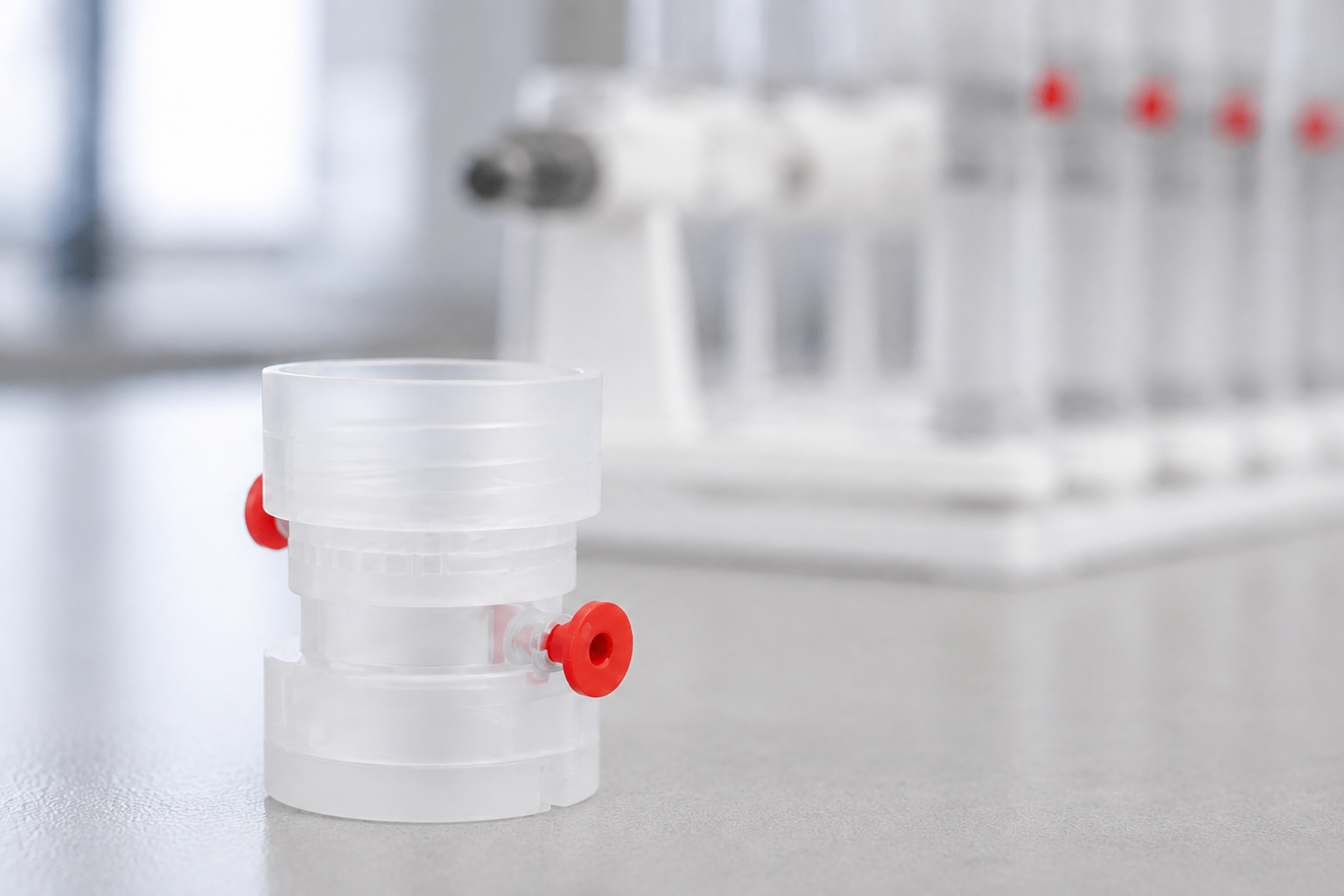
The challenges of field filtration can be overcome with the DigiFILTER Field Kit. The kit comprises DigiFILTERs with 0.45 µm membranes and DigiTUBEs for sample collection and storage. DigiFILTERs can be used in the field with a plastic syringe, allowing single-sample filtration at or near the point of collection before the sample is containerized for transport. Implementing filtration in the field means the sample that reaches the lab reflects actual field chemistry, not field chemistry modified by an extended period in a sample bottle.
Achieving the best filtration results
Getting filtration right isn’t complicated, but does require deliberate choices — choices that influence the accuracy of the results that follow. The decisions involved in membrane and pore size selection reduce to a practical sequence:
- Identify the relevant standard method and confirm whether it specifies a pore size or membrane material.
- If it does, follow the specification.
- If it doesn’t, assess the sample matrix: high particulate load requires a larger pore size; acid digestion matrices require PTFE.
- Consider whether field filtration is appropriate given sample type and transport conditions.
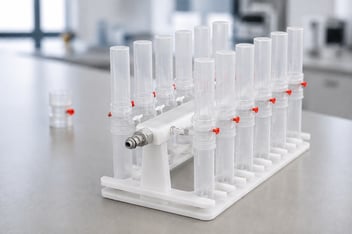
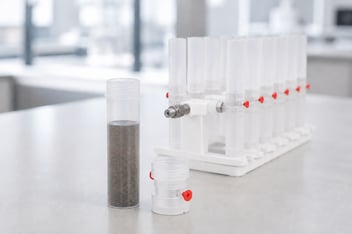
Our DigiFILTERs are available with a range of membrane and pore size options, and are designed from the outset for seamless integration with our 50 ml and 100 ml DigiTUBE digestion tubes, keeping materials chemistry consistent across the sample preparation workflow. If you’re unsure, contact our technical team for advice on product selection. DigiTUBEs and DigiFILTERs used in conjunction with the DigiFILTER manifold, form an integrated system, with a single, documented chain from digestion to filtration to dilution. A short animation covering our DigiFILTERs, DigiTUBEs, and showing the manifold in action is available to view here.
To learn more, read the other blogs in this series, Why Filtration is the Step Your ICP Results Depend On and Your ICP Results Are Only as Good as Your Sample Preparation, visit our literature library, or contact our team to discuss your specific requirements.
Frequently Asked Questions
What pore size should I use for drinking water analysis by ICP-MS?
Can I use PTFE membranes with hydrofluoric acid?
My filter’s blocked before I’ve processed the full sample volume — what should I do?
Is glass fiber suitable for trace metal analysis after acid digestion?
How can I tell whether my filter’s contributing to my results?
Subscribe to our blog